RESEARCH
This section presents the research outputs of #NextGenC. These studies explore how young people, local governments, and other urban actors use digital tools and innovative forms of governance, identifying both progress and challenges in youth participation in the digital age. The documents available here connect academic evidence with the experiences and realities of young people, while also providing insights to strengthen more democratic and inclusive urban governance.

Featured Publications
Guide
This guide is designed for young people in Manizales, offering support, care, and guidance on mental health issues. It includes the experiences and challenges identified by young individuals, along with recommendations for strengthening support networks, promoting youth leadership, encouraging self-care, improving access to care pathways, and enhancing emotional well-being.
All posts
Case study
Friederike Fleischer, María Cecilia Dedios, Luisa Fernanda Leyton, Daniel Sánchez, Ilsa Banuvi Caizamo, Julio Cesar Rodríguez y Kathleen Palacios., 2025
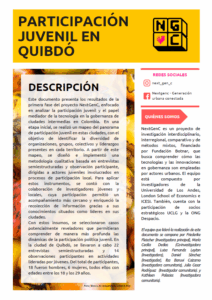
The document presents the findings from the first phase of the NextGenC project in Quibdo. This article analyzes youth participation and the role of technology in local governance using qualitative methodologies, including 22 interviews and 14 observations. The study highlights a challenging context, with Quibdo having the highest monetary poverty rate in Colombia at 60.1% and significant youth unemployment. The city is also affected by the consequences of armed conflict and a loss of ethnic identity. In response to these challenges, Afro-descendant and Indigenous youth engage in collective community participation that is closely linked to their worldviews. Their efforts focus on peacebuilding, human rights, education, and cultural preservation. The methods of action they employ include training programs, in-person community involvement, protests, and artistic activities. These initiatives are organized through both informal collectives and traditional organizations, as well as institutional platforms.
Case study
Friederike Fleischer, María Cecilia Dedios, Luisa Fernanda Leyton, Daniel Sánchez y Jaher Ren, 2025
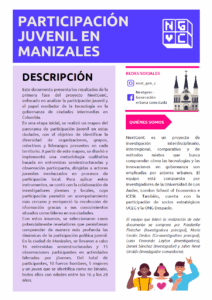
The document outlines the findings from the first phase of the NextGenC project in Manizales, focusing on youth participation and the use of technology in local governance. Using a qualitative methodology that included 16 interviews and 15 observations, the project characterized young people in a university city known for its high educational coverage but also facing challenges related to employment and inclusion. The conclusion indicates that youth participation is split between the institutional sphere, which includes platforms, councils, and cabinets, and is hindered by political rivalries and limited real-world impact, and the non-institutional sphere, represented by independent collectives. In the non-institutional sphere, young people actively seek safer and more structured spaces that facilitate direct community impact.
Case study
Equipo NextGenC — LSE Cities, Universidad ICESI (POLIS), Universidad de los Andes, CGLU y Despacio, 2024
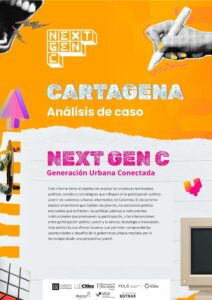
This analysis explores the territorial, political, and technological factors that influence youth political participation in Cartagena. It examines the socioeconomic challenges faced by young people, including unemployment, poverty, insecurity, and the digital divide. Additionally, the document discusses the scenarios of political-electoral representation, public policy tools aimed at youth, and the connections between urban governance, youth participation, and advancements in science, technology, and innovation. The findings are based on interviews, focus groups, and social mapping conducted with institutional actors and youth councilors from three district localities.

Guide
NextGenC, 2026
This guide was created in collaboration with Indigenous youth in Quibdo to identify issues related to gender-based violence and to gather recommendations for organizational processes and youth leadership. The document focuses on prevention, support, care pathways, community strengthening, spiritual healing, youth participation, and safety in digital spaces.
Guide
NextGenC, 2026
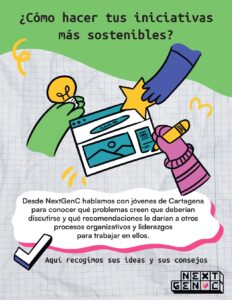
This guide is based on discussions with young people in Cartagena regarding the challenges their youth initiatives face and offers recommendations for strengthening these initiatives. It covers key areas such as resource management, project sustainability, building networks and partnerships, securing funding, training, leadership development, community participation, and the strategic use of social media.
Case study
Equipo NextGenC — LSE Cities, Universidad ICESI (POLIS), Universidad de los Andes, CGLU y Despacio, 2024
This document provides a comparative analysis of the relationship between technology, innovation, and youth political participation in Cartagena, Manizales, and Quibdo. It explores how digital divides and socioeconomic conditions restrict young people's access to technology, the development of public policies related to Science, Technology, and Innovation (STI), institutional fragmentation, and the untapped potential of digital tools for enhancing citizen participation. The findings are based on 50 interviews, focus groups, and social mapping conducted with both institutional and youth representatives. The study indicates that digital exclusion, the disconnect between STI and youth policies, and the absence of budgets and measurable indicators hinder the development of digital youth citizenship in these three cities.
Summary
Lina Martínez María, Isabel Zafra María y María Fernanda Alomia, 2024
This document reviews the concepts of urban governance—decentralization, participation, and smart governance—on a global scale, with a particular focus on Latin America and Colombia. It demonstrates that decentralization has significantly transformed local governance in the region, though the results have been uneven. While it has increased citizen participation, it has also exacerbated institutional weaknesses, territorial inequities, and distrust in the state. Intermediate cities, which are home to 32% of the regional population, face unique challenges related to fiscal capacity, citizen participation, and the adoption of technology. In Colombia, these issues are further complicated by the ongoing armed conflict and the peace process. Additionally, the integration of technology into urban governance is still in its early stages and is primarily concentrated in larger cities. This reveals a digital divide and a capacity gap that limits digital citizen participation in intermediate territories.
Summary
Fleischer, Dedios Sanguineti, Delgado Martinez, Sanchez Vega, Moncaleano Arboleda, Universidad de los Andes, 2024
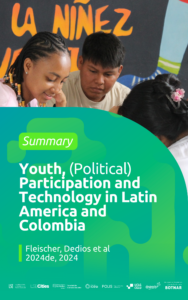
The article reviews academic literature on youth participation and politics, focusing on their connections with technology and activism in Latin America, particularly Colombia. It highlights that current forms of participation occur in non-traditional spaces, characterized by horizontal organization and bottom-up decision-making, along with an increasing role of technology. The text also points out gaps in existing research, such as the lack of studies conducted in intermediate or small cities, the absence of decolonial and intersectional perspectives, and limited analysis of technology's role in activism.
Case study
Cifras y Conceptos, Fundación Corona, LSE, Next Gen C, Fundación Bolivar Davivienda, El Tiempo, 2026
The study examines the perceptions, opinions, and behaviors of young people in Colombia concerning various topics, including democracy, the national government, political participation, the 2026 elections, education, the labor market, digital participation, new youth identities, and emotions. It gathers information about sociodemographic conditions, the main concerns of young people, and the different ways they engage in social and political participation.
Case study
Cifras y Conceptos, Fundación Corona, LSE, Next Gen C, Fundación Bolívar Davivienda, El Tiempo. 2025
The study examines the perceptions, opinions, and behaviors of young people in Manizales on several topics, including democracy, the national government, political participation, and the elections. It also explores issues related to education, the labor market, digital participation, emerging youth identities, and emotions. The research gathers information about the sociodemographic conditions of Manizales's youth, their primary concerns, and their methods of social and political engagement.

Case study
Cifras y Conceptos, Fundación Corona, LSE, Next Gen C, Fundación Bolívar Davivienda, El Tiempo. 2026
The study examines the perceptions, opinions, and behaviors of young people in Quibdo on several topics, including democracy, the national government, political participation, and the 2026 elections. It also explores issues related to education, the labor market, digital participation, emerging youth identities, and emotions. The research gathers information about the sociodemographic conditions of Quibdo's youth, their primary concerns, and their methods of social and political engagement.
Case study
Friederike Fleischer, María Cecilia Dedios, Luisa Fernanda Leyton, Daniel Sánchez, e Isamar Julio, 2025
Este documento presenta los resultados de la primera fase del proyecto NextGenC, enfocado en analizar la participación juvenil y el papel mediador de la tecnología en la gobernanza de ciudades intermedias en Colombia. En una etapa inicial, se realizó un mapeo del panorama de participación juvenil en estas ciudades con el objetivo de identificar la diversidad de organizaciones, grupos, colectivos y liderazgos presentes en cada territorio. A partir de este mapeo, se diseñó e implementó una metodología cualitativa basada en entrevistas semiestructuradas y observación participante, dirigida a actores juveniles involucrados en procesos de participación local. Para aplicar estos instrumentos, se contó con la colaboración de investigadores jóvenes y locales, cuya participación permitió un acompañamiento más cercano y enriqueció la recolección de información.
Case study
Equipo NextGenC — LSE Cities, Universidad ICESI (POLIS), Universidad de los Andes, CGLU y Despacio, 2024
This document analyzes the territorial, political, social, and technological factors influencing youth political participation in Quibdo. It explores the socioeconomic context, including issues such as poverty, unemployment, insecurity, and the digital divide. The analysis also considers political-electoral representation scenarios and public policy instruments aimed at youth and technology. Additionally, it examines the intersection of governance, youth participation, and science and innovation. The findings are based on interviews, focus groups, and social mapping conducted with institutional actors and youth councilors. The study highlights a significant gap between the normative recognition of young people and the structural conditions necessary for their effective participation.
Case study
Equipo NextGenC — LSE Cities, Universidad ICESI (POLIS), Universidad de los Andes, CGLU y Despacio, 2024
This document analyzes the territorial, political, social, and technological dynamics that influence youth political participation in Manizales. It explores the socioeconomic challenges facing young people, including unemployment, educational disparities, and mental health issues. The analysis also considers the scenarios for political and electoral representation, public policy initiatives designed for youth, and the relationship between governance, youth engagement, and science and innovation. The findings are based on 24 interviews, focus groups, and social mapping conducted with institutional actors, academics, and youth councilors. The study reveals a tension between the formal recognition of young people and the structural conditions that restrict their effective participation.

Guide
NextGenC, 2026
This guide is based on conversations with young people in Quibdo regarding the challenges and opportunities for strengthening youth initiatives. It addresses various topics, including the sustainability of youth organizations, training, leadership development, the pursuit of opportunities, participation, network-building, access to funding opportunities, and tools for consolidating youth initiatives.
Guide
NextGenC, 2026
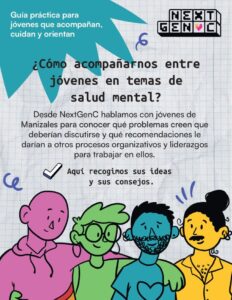
This guide is designed for young people in Manizales, offering support, care, and guidance on mental health issues. It includes the experiences and challenges identified by young individuals, along with recommendations for strengthening support networks, promoting youth leadership, encouraging self-care, improving access to care pathways, and enhancing emotional well-being.
Case study
Equipo NextGenC — LSE Cities, Universidad ICESI (POLIS), Universidad de los Andes, CGLU y Despacio, 2024
This document presents a comparative analysis of the factors influencing youth political participation in Cartagena, Manizales, and Quibdo. It explores how socioeconomic conditions—such as poverty, unemployment, insecurity, and mental health—limit young people's ability to exercise their citizenship. The study also examines the existence and effectiveness of institutional mechanisms for participation, the fragmentation and inconsistency of policies and programs, and the tension between the symbolic recognition of youth and the insufficient institutional support they receive. The findings are based on 50 interviews, focus groups, and social mapping conducted with institutional representatives and youth participants. The study reveals that, despite advancements in regulations, structural barriers continue to diminish youth participation, often relegating it to symbolic spaces that have little real impact.
Summary
LSE Cities, 2024
This document reviews publications from international organizations such as the OECD, UN-Habitat, World Bank, USAID, and IDB, focusing on urban governance, youth, and technology. It identifies key socioeconomic challenges faced by urban youth, including unemployment, poverty, and political underrepresentation. Additionally, the document explores technology-based solutions designed to enhance youth participation in governance. It emphasizes people-centered smart city initiatives, digital participatory budgeting, and public policy frameworks that promote youth entrepreneurship and intergenerational equity.
Summary
Nuno F. da Cruz y Philipp Rode, 2024
This document presents a systematic review of academic literature focusing on the intersection of urban governance, youth participation, and digital technology. It analyzes 62 publications identified in the Web of Science, with 13 being highly relevant to the NextGenC project. The findings indicate a limited amount of recent academic output, primarily concentrated in the Global North. This confirms the project's potential to address existing gaps in intermediate cities in Colombia and Latin America from a social sciences perspective.
Summary
Imogen Hamilton-Jones, Philipp Rode y Andres Lombana Bermudez., 2024
The document explores how digital tools are changing the political participation of young people in urban settings around the world. It concludes that digital and in-person engagement are closely interconnected in cities. The document classifies the technologies used by youth into three categories: youth social networks, community co-production tools, and government e-participation initiatives. It analyzes the levels of engagement, which include organization, contribution, and follow-up. Additionally, the text highlights risks such as algorithmic bubbles and state repression. It identifies gaps in current research, including an excessive focus on social media, a lack of consideration for the physical urban environment, and a significant geographic imbalance that overlooks the Global South.

Case study
Cifras y Conceptos, Fundación Corona, LSE, Next Gen C, Fundación Bolívar Davivienda, El Tiempo. 2026
The study examines the perceptions, opinions, and behaviors of young people in Cartagena on several topics, including democracy, the national government, political participation, and the 2026 elections. It also explores issues related to education, the labor market, digital participation, emerging youth identities, and emotions. The research gathers information about the sociodemographic conditions of Cartagena's youth, their primary concerns, and their methods of social and political engagement.
Case study
Friederike Fleischer, María Cecilia Dedios, Luisa Fernanda Leyton, Daniel Sánchez, Ilsa Banuvi Caizamo, Julio Cesar Rodríguez y Kathleen Palacios., 2025
The document presents the findings from the first phase of the NextGenC project in Quibdo. This article analyzes youth participation and the role of technology in local governance using qualitative methodologies, including 22 interviews and 14 observations. The study highlights a challenging context, with Quibdo having the highest monetary poverty rate in Colombia at 60.1% and significant youth unemployment. The city is also affected by the consequences of armed conflict and a loss of ethnic identity. In response to these challenges, Afro-descendant and Indigenous youth engage in collective community participation that is closely linked to their worldviews. Their efforts focus on peacebuilding, human rights, education, and cultural preservation. The methods of action they employ include training programs, in-person community involvement, protests, and artistic activities. These initiatives are organized through both informal collectives and traditional organizations, as well as institutional platforms.
Guide
NextGenC, 2026
This guide was created in collaboration with Indigenous youth in Quibdo to identify issues related to gender-based violence and to gather recommendations for organizational processes and youth leadership. The document focuses on prevention, support, care pathways, community strengthening, spiritual healing, youth participation, and safety in digital spaces.
Case study
Equipo NextGenC — LSE Cities, Universidad ICESI (POLIS), Universidad de los Andes, CGLU y Despacio, 2024
This document provides a comparative analysis of the relationship between technology, innovation, and youth political participation in Cartagena, Manizales, and Quibdo. It explores how digital divides and socioeconomic conditions restrict young people's access to technology, the development of public policies related to Science, Technology, and Innovation (STI), institutional fragmentation, and the untapped potential of digital tools for enhancing citizen participation. The findings are based on 50 interviews, focus groups, and social mapping conducted with both institutional and youth representatives. The study indicates that digital exclusion, the disconnect between STI and youth policies, and the absence of budgets and measurable indicators hinder the development of digital youth citizenship in these three cities.
Case study
Cifras y Conceptos, Fundación Corona, LSE, Next Gen C, Fundación Bolívar Davivienda, El Tiempo. 2026
The study examines the perceptions, opinions, and behaviors of young people in Quibdo on several topics, including democracy, the national government, political participation, and the 2026 elections. It also explores issues related to education, the labor market, digital participation, emerging youth identities, and emotions. The research gathers information about the sociodemographic conditions of Quibdo's youth, their primary concerns, and their methods of social and political engagement.
Case study
Equipo NextGenC — LSE Cities, Universidad ICESI (POLIS), Universidad de los Andes, CGLU y Despacio, 2024
This document analyzes the territorial, political, social, and technological factors influencing youth political participation in Quibdo. It explores the socioeconomic context, including issues such as poverty, unemployment, insecurity, and the digital divide. The analysis also considers political-electoral representation scenarios and public policy instruments aimed at youth and technology. Additionally, it examines the intersection of governance, youth participation, and science and innovation. The findings are based on interviews, focus groups, and social mapping conducted with institutional actors and youth councilors. The study highlights a significant gap between the normative recognition of young people and the structural conditions necessary for their effective participation.
Guide
NextGenC, 2026
This guide is based on conversations with young people in Quibdo regarding the challenges and opportunities for strengthening youth initiatives. It addresses various topics, including the sustainability of youth organizations, training, leadership development, the pursuit of opportunities, participation, network-building, access to funding opportunities, and tools for consolidating youth initiatives.
Case study
Equipo NextGenC — LSE Cities, Universidad ICESI (POLIS), Universidad de los Andes, CGLU y Despacio, 2024
This document presents a comparative analysis of the factors influencing youth political participation in Cartagena, Manizales, and Quibdo. It explores how socioeconomic conditions—such as poverty, unemployment, insecurity, and mental health—limit young people's ability to exercise their citizenship. The study also examines the existence and effectiveness of institutional mechanisms for participation, the fragmentation and inconsistency of policies and programs, and the tension between the symbolic recognition of youth and the insufficient institutional support they receive. The findings are based on 50 interviews, focus groups, and social mapping conducted with institutional representatives and youth participants. The study reveals that, despite advancements in regulations, structural barriers continue to diminish youth participation, often relegating it to symbolic spaces that have little real impact.
Case study
Friederike Fleischer, María Cecilia Dedios, Luisa Fernanda Leyton, Daniel Sánchez, e Isamar Julio, 2025
Este documento presenta los resultados de la primera fase del proyecto NextGenC, enfocado en analizar la participación juvenil y el papel mediador de la tecnología en la gobernanza de ciudades intermedias en Colombia. En una etapa inicial, se realizó un mapeo del panorama de participación juvenil en estas ciudades con el objetivo de identificar la diversidad de organizaciones, grupos, colectivos y liderazgos presentes en cada territorio. A partir de este mapeo, se diseñó e implementó una metodología cualitativa basada en entrevistas semiestructuradas y observación participante, dirigida a actores juveniles involucrados en procesos de participación local. Para aplicar estos instrumentos, se contó con la colaboración de investigadores jóvenes y locales, cuya participación permitió un acompañamiento más cercano y enriqueció la recolección de información.
Guide
NextGenC, 2026
This guide is based on discussions with young people in Cartagena regarding the challenges their youth initiatives face and offers recommendations for strengthening these initiatives. It covers key areas such as resource management, project sustainability, building networks and partnerships, securing funding, training, leadership development, community participation, and the strategic use of social media.
Case study
Equipo NextGenC — LSE Cities, Universidad ICESI (POLIS), Universidad de los Andes, CGLU y Despacio, 2024
This document provides a comparative analysis of the relationship between technology, innovation, and youth political participation in Cartagena, Manizales, and Quibdo. It explores how digital divides and socioeconomic conditions restrict young people's access to technology, the development of public policies related to Science, Technology, and Innovation (STI), institutional fragmentation, and the untapped potential of digital tools for enhancing citizen participation. The findings are based on 50 interviews, focus groups, and social mapping conducted with both institutional and youth representatives. The study indicates that digital exclusion, the disconnect between STI and youth policies, and the absence of budgets and measurable indicators hinder the development of digital youth citizenship in these three cities.
Case study
Equipo NextGenC — LSE Cities, Universidad ICESI (POLIS), Universidad de los Andes, CGLU y Despacio, 2024
This analysis explores the territorial, political, and technological factors that influence youth political participation in Cartagena. It examines the socioeconomic challenges faced by young people, including unemployment, poverty, insecurity, and the digital divide. Additionally, the document discusses the scenarios of political-electoral representation, public policy tools aimed at youth, and the connections between urban governance, youth participation, and advancements in science, technology, and innovation. The findings are based on interviews, focus groups, and social mapping conducted with institutional actors and youth councilors from three district localities.
Case study
Equipo NextGenC — LSE Cities, Universidad ICESI (POLIS), Universidad de los Andes, CGLU y Despacio, 2024
This document presents a comparative analysis of the factors influencing youth political participation in Cartagena, Manizales, and Quibdo. It explores how socioeconomic conditions—such as poverty, unemployment, insecurity, and mental health—limit young people's ability to exercise their citizenship. The study also examines the existence and effectiveness of institutional mechanisms for participation, the fragmentation and inconsistency of policies and programs, and the tension between the symbolic recognition of youth and the insufficient institutional support they receive. The findings are based on 50 interviews, focus groups, and social mapping conducted with institutional representatives and youth participants. The study reveals that, despite advancements in regulations, structural barriers continue to diminish youth participation, often relegating it to symbolic spaces that have little real impact.
Case study
Cifras y Conceptos, Fundación Corona, LSE, Next Gen C, Fundación Bolívar Davivienda, El Tiempo. 2026
The study examines the perceptions, opinions, and behaviors of young people in Cartagena on several topics, including democracy, the national government, political participation, and the 2026 elections. It also explores issues related to education, the labor market, digital participation, emerging youth identities, and emotions. The research gathers information about the sociodemographic conditions of Cartagena's youth, their primary concerns, and their methods of social and political engagement.
Case study
Friederike Fleischer, María Cecilia Dedios, Luisa Fernanda Leyton, Daniel Sánchez y Jaher Ren, 2025
The document outlines the findings from the first phase of the NextGenC project in Manizales, focusing on youth participation and the use of technology in local governance. Using a qualitative methodology that included 16 interviews and 15 observations, the project characterized young people in a university city known for its high educational coverage but also facing challenges related to employment and inclusion. The conclusion indicates that youth participation is split between the institutional sphere, which includes platforms, councils, and cabinets, and is hindered by political rivalries and limited real-world impact, and the non-institutional sphere, represented by independent collectives. In the non-institutional sphere, young people actively seek safer and more structured spaces that facilitate direct community impact.
Guide
NextGenC, 2026
This guide is designed for young people in Manizales, offering support, care, and guidance on mental health issues. It includes the experiences and challenges identified by young individuals, along with recommendations for strengthening support networks, promoting youth leadership, encouraging self-care, improving access to care pathways, and enhancing emotional well-being.
Case study
Equipo NextGenC — LSE Cities, Universidad ICESI (POLIS), Universidad de los Andes, CGLU y Despacio, 2024
This document provides a comparative analysis of the relationship between technology, innovation, and youth political participation in Cartagena, Manizales, and Quibdo. It explores how digital divides and socioeconomic conditions restrict young people's access to technology, the development of public policies related to Science, Technology, and Innovation (STI), institutional fragmentation, and the untapped potential of digital tools for enhancing citizen participation. The findings are based on 50 interviews, focus groups, and social mapping conducted with both institutional and youth representatives. The study indicates that digital exclusion, the disconnect between STI and youth policies, and the absence of budgets and measurable indicators hinder the development of digital youth citizenship in these three cities.
Case study
Equipo NextGenC — LSE Cities, Universidad ICESI (POLIS), Universidad de los Andes, CGLU y Despacio, 2024
This document analyzes the territorial, political, social, and technological dynamics that influence youth political participation in Manizales. It explores the socioeconomic challenges facing young people, including unemployment, educational disparities, and mental health issues. The analysis also considers the scenarios for political and electoral representation, public policy initiatives designed for youth, and the relationship between governance, youth engagement, and science and innovation. The findings are based on 24 interviews, focus groups, and social mapping conducted with institutional actors, academics, and youth councilors. The study reveals a tension between the formal recognition of young people and the structural conditions that restrict their effective participation.
Case study
Equipo NextGenC — LSE Cities, Universidad ICESI (POLIS), Universidad de los Andes, CGLU y Despacio, 2024
This document presents a comparative analysis of the factors influencing youth political participation in Cartagena, Manizales, and Quibdo. It explores how socioeconomic conditions—such as poverty, unemployment, insecurity, and mental health—limit young people's ability to exercise their citizenship. The study also examines the existence and effectiveness of institutional mechanisms for participation, the fragmentation and inconsistency of policies and programs, and the tension between the symbolic recognition of youth and the insufficient institutional support they receive. The findings are based on 50 interviews, focus groups, and social mapping conducted with institutional representatives and youth participants. The study reveals that, despite advancements in regulations, structural barriers continue to diminish youth participation, often relegating it to symbolic spaces that have little real impact.
Case study
Cifras y Conceptos, Fundación Corona, LSE, Next Gen C, Fundación Bolívar Davivienda, El Tiempo. 2025
The study examines the perceptions, opinions, and behaviors of young people in Manizales on several topics, including democracy, the national government, political participation, and the elections. It also explores issues related to education, the labor market, digital participation, emerging youth identities, and emotions. The research gathers information about the sociodemographic conditions of Manizales's youth, their primary concerns, and their methods of social and political engagement.
Summary
Lina Martínez María, Isabel Zafra María y María Fernanda Alomia, 2024
This document reviews the concepts of urban governance—decentralization, participation, and smart governance—on a global scale, with a particular focus on Latin America and Colombia. It demonstrates that decentralization has significantly transformed local governance in the region, though the results have been uneven. While it has increased citizen participation, it has also exacerbated institutional weaknesses, territorial inequities, and distrust in the state. Intermediate cities, which are home to 32% of the regional population, face unique challenges related to fiscal capacity, citizen participation, and the adoption of technology. In Colombia, these issues are further complicated by the ongoing armed conflict and the peace process. Additionally, the integration of technology into urban governance is still in its early stages and is primarily concentrated in larger cities. This reveals a digital divide and a capacity gap that limits digital citizen participation in intermediate territories.
Summary
Fleischer, Dedios Sanguineti, Delgado Martinez, Sanchez Vega, Moncaleano Arboleda, Universidad de los Andes, 2024
The article reviews academic literature on youth participation and politics, focusing on their connections with technology and activism in Latin America, particularly Colombia. It highlights that current forms of participation occur in non-traditional spaces, characterized by horizontal organization and bottom-up decision-making, along with an increasing role of technology. The text also points out gaps in existing research, such as the lack of studies conducted in intermediate or small cities, the absence of decolonial and intersectional perspectives, and limited analysis of technology's role in activism.
Study
Cifras y Conceptos, Fundación Corona, LSE, Next Gen C, Fundación Bolivar Davivienda, El Tiempo, 2026
The study examines the perceptions, opinions, and behaviors of young people in Colombia concerning various topics, including democracy, the national government, political participation, the 2026 elections, education, the labor market, digital participation, new youth identities, and emotions. It gathers information about sociodemographic conditions, the main concerns of young people, and the different ways they engage in social and political participation.
Summary
LSE Cities, 2024
This document reviews publications from international organizations such as the OECD, UN-Habitat, World Bank, USAID, and IDB, focusing on urban governance, youth, and technology. It identifies key socioeconomic challenges faced by urban youth, including unemployment, poverty, and political underrepresentation. Additionally, the document explores technology-based solutions designed to enhance youth participation in governance. It emphasizes people-centered smart city initiatives, digital participatory budgeting, and public policy frameworks that promote youth entrepreneurship and intergenerational equity.
Summary
Nuno F. da Cruz y Philipp Rode, 2024
This document presents a systematic review of academic literature focusing on the intersection of urban governance, youth participation, and digital technology. It analyzes 62 publications identified in the Web of Science, with 13 being highly relevant to the NextGenC project. The findings indicate a limited amount of recent academic output, primarily concentrated in the Global North. This confirms the project's potential to address existing gaps in intermediate cities in Colombia and Latin America from a social sciences perspective.
Summary
Imogen Hamilton-Jones, Philipp Rode y Andres Lombana Bermudez., 2024
The document explores how digital tools are changing the political participation of young people in urban settings around the world. It concludes that digital and in-person engagement are closely interconnected in cities. The document classifies the technologies used by youth into three categories: youth social networks, community co-production tools, and government e-participation initiatives. It analyzes the levels of engagement, which include organization, contribution, and follow-up. Additionally, the text highlights risks such as algorithmic bubbles and state repression. It identifies gaps in current research, including an excessive focus on social media, a lack of consideration for the physical urban environment, and a significant geographic imbalance that overlooks the Global South.
*The original documents are in English. The translation is done automatically
At NextGenC, we set out to collect socioeconomic data to analyze technology-driven political participation among young people in Colombia and to help us identify the three pilot cities with which we would work most closely. Below, you’ll find a dashboard that presents a summary of some of the most relevant indicators, focusing on 14 cities across the country. You can also access the complete database, which includes 95 cities, by downloading the file available on the right.