#NextGenC at the Third Meeting of the Hub Conexión Juvenil (Youth Connection Hub): Turning Young Voices into Transformative Decisions


Photo: Hub Conexión Juvenil
What does it take for the ideas of young people to become actionable decisions? On October 1st and 2nd, #NextGenC participated in the third National Learning Meeting of the Hub Conexión Juvenil in Bogotá. During this event, we shared insights on youth participation and mental health, and learned from individuals dedicated to transforming the realities faced by young people in their communities.
Over the course of two days, young leaders, social organisations, universities, and institutions gathered at the Universidad de Los Andes for conversations, games, shared experiences, and discussions. The goal was to exchange knowledge on three critical issues affecting young people in Colombia: participation, employment, and mental health. Participants aimed to connect this knowledge with concrete actions to address these challenges.
For #NextGenC, participating in the third National Learning Meeting of the Hub Conexión Juvenil was an opportunity to connect the lessons learned from three years of research on youth in mid-sized cities with the experiences of other stakeholders across the country. Along with contributing to discussions on youth participation and mental health, the project represented the universities and organisations involved, strengthening the dialogue between research and the initiatives being developed in local communities.
How can one transform having a voice into influencing decisions?
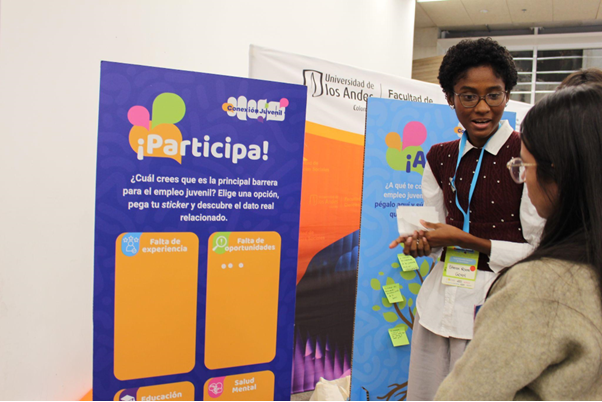
Photo: Hub Conexión Juvenil
A key highlight of the meeting was the launch of Voces que inciden (Voices that make an impact), a simulation game developed by the Participation Committee of the Hub Conexión Juvenil. This game encourages young people, organisations, and institutions to engage with dilemmas surrounding political participation. It invites participants to deliberate from various perspectives and work towards building collective agreements. Rather than just discussing participation, players actively practice it by discussing alternatives, voting, and deciding how to respond to situations that require coordination among different actors.
Daniel Sánchez, a member of NextGenC representing the Faculty of Social Sciences at the University de Los Andes, emphasised the importance of meeting with individuals from various sectors and organisations to gain a deeper understanding of how youth participation is experienced and developed.
“It was very enriching because we were able to discuss how each of us perceives youth participation and what insights we are gaining from it,” he said.
This exercise facilitated a discussion about three essential conditions for effective participation: the legitimacy of the spaces, trust among participants, and the necessary coordination to reach agreements. The central question is how to ensure that young people are not only invited to share their opinions but also have access to spaces where they can influence decisions that impact their communities.
Listening to the voices of young people also provides valuable evidence
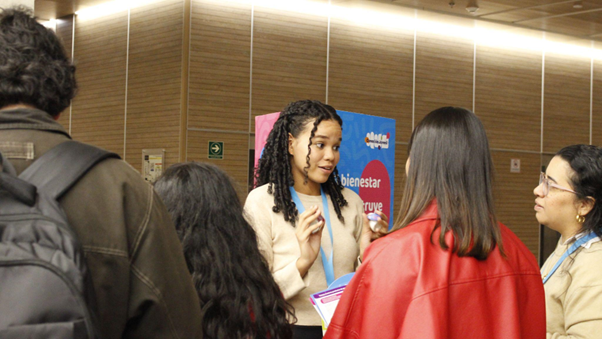
Photo: Hub Conexión Juvenil
Participation was not the only key topic that linked research with local experiences. During the Mental Health roundtable, discussions centred on understanding youth well-being and identifying strategies to address young people’s needs in their daily lives.
At this event, NextGenC, in collaboration with POLIS, presented evidence and metrics on mental health in Cali to support informed decision-making. Lina Martínez, one of the principal investigators at NextGenC, stressed that while it's important to know the statistics, it is equally crucial to listen directly to young people to determine which solutions can be developed in each area.
“Today, we focused on mental health, which significantly impacts the well-being of young people in Colombia. We listened to their voices and discussed specific strategies we can implement in different communities”, Lina explained.
Her presentation highlighted a core principle of the project: connecting research with the experiences of young people and the organisations that support them. Evidence helps to identify challenges and informs decision-making, while engaging in dialogue with those who experience these realities allows the project to understand the specificities of each context. Integrating these two elements is crucial to ensure that solutions are developed in alignment with young people’s needs.
Behind every youth initiative, there is a network that makes it possible
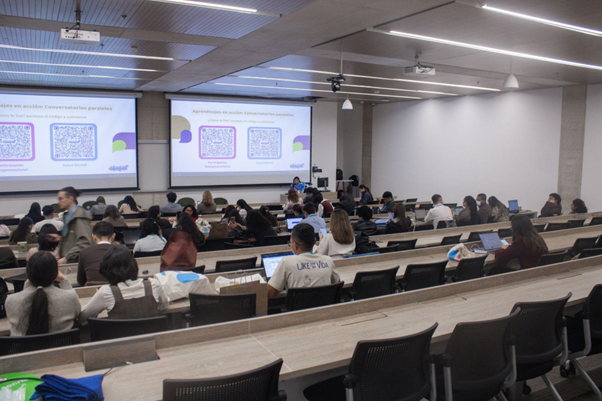
Photo: Hub Conexión Juvenil
The meeting provided valuable insights into the experiences of young people leading social movements across the country, going beyond just the tools and publications presented. Their stories highlighted that effective youth leadership relies not only on the ideas and determination of those in leadership roles but also requires time, resources, support, and collaborative networks.
Heidi, a young participant from Bogotá, stressed the importance of transitioning from learning to taking action and expanding support so that more young people can join these initiatives. Drawing from her own experiences, she noted that the assistance she received was crucial for her participation and for sharing her contributions. Her reflections brought attention to a barrier often overlooked in discussions about participation: not all young people have the necessary resources to access the spaces where decisions are made and experiences are shared.
A key lesson about leadership has become clear: recognising the limits of individual capabilities, listening to diverse perspectives, and collaborating with others lead to more sustainable processes. Connecting young people, organisations, businesses, academia, and institutions is not just an enhancement to these efforts; it is essential for enabling initiatives to grow and endure.
The next step is to transform these lessons learned into concrete changes
The third National Learning Meeting of the Hub Conexión Juvenil highlighted a shared goal: to improve the connection between evidence, youth experiences, and the capabilities of those who can help transform their living conditions. For NextGenC, participation involved sharing research knowledge, facilitating discussions on advocacy and well-being, and learning from initiatives that are creating solutions at the grassroots level.
This experience also reinforced the idea that participation, employment, and mental health should not be viewed as separate issues. Young people's opportunities depend on various factors and require coordinated responses, developed in collaboration with those who understand their realities and can contribute to transforming them.