

Cartagena, Bolívar

Colombia Faces A Historic Electoral Decision
Photo credit: Jordan Jiménez Barrios
Colombia Faces A Historic Electoral Decision

Jordan Jiménez Barrios
Youth Leader
/ @Jordajimenez09
Amid the polarization currently affecting the country, Colombia’s electoral context ahead of the presidential runoff offers an opportunity to reflect on several historical factors and events that help us understand the present political moment.
According to information provided by the National Civil Registry, 23,978,304 of the 41,421,973 Colombians eligible to vote participated in the presidential election held on Sunday, May 31, 2026, representing a turnout of 57.88%. This figure becomes particularly significant when compared with previous periods of low electoral participation. According to the Electoral Observation Mission (MOE) and official data from the National Civil Registry, turnout in the first round of the 2014 presidential election was 40.08%.
These figures can be interpreted positively; however, in some municipalities across the country, exercising the right to vote remains a major challenge. Factors such as geographic location, lack of access to transportation, poverty, violence, and the limited institutional presence of the State continue to affect electoral participation. This reality shows that, beyond the high turnout recorded in the most recent election, we still face a historic deficit in the guarantees and conditions necessary for all Colombian men and women to fully exercise their political and electoral rights.
One example is that, despite the increase in participation, electoral abstention still represented approximately 42.12% of eligible voters. This shows that structural barriers continue to limit effective access to democratic participation for large sectors of the country.
Beyond the high electoral turnout recorded in the most recent election, we still face a historic deficit in the guarantees and conditions necessary for all Colombian men and women to fully exercise their political and electoral rights.
On the other hand, Colombia’s left achieved in 2026 the highest vote total ever obtained by this political sector in the first round of a presidential election, with 9,688,360 votes. This result reflects the changes taking place in the country’s political culture, as what for many years was considered a marginal alternative now represents a governing option supported by millions of Colombian men and women.
It is also important to recognize that, for more than two centuries of republican history, Colombia was governed by traditional right-wing and center-right political sectors, until August 7, 2022, when Gustavo Petro took office as the first left-wing president in the country’s history. This event marked a turning point in Colombian politics and represents a fundamental precedent for understanding the current electoral landscape.
These developments are far from insignificant when it comes to understanding the social and political context we are experiencing. While millions of Colombian men and women argue that the country carries a historic debt in terms of social justice and believe it is necessary to deepen the reforms promoted by the current government, other sectors propose making progress on social issues while prioritizing the private sector and strengthening security as central pillars of their political agenda. This clash of visions regarding the country’s direction is reflected in the election results, particularly in the vote received by the right-wing candidate, who obtained 10,361,499 votes.
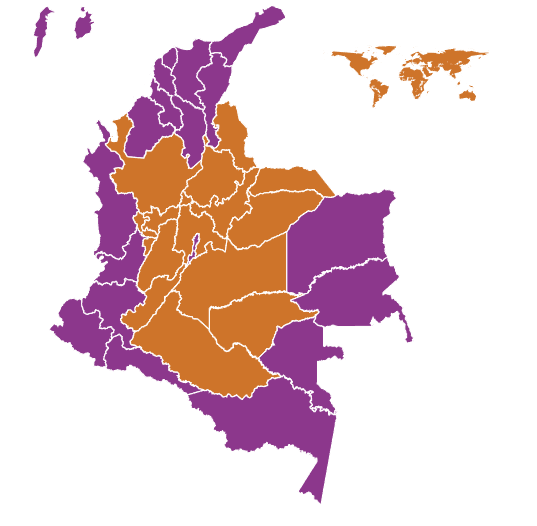
To analyze the figures mentioned above regarding electoral participation and the vote received by the presidential candidates, it is important to understand how the country is expressing itself through its regions. It is striking that in the Caribbean, Pacific, and Amazon regions, the highest share of the vote went to the left-wing candidate, while in the Andean region and much of the center of the country, the right-wing vote prevailed.
This phenomenon cannot be understood separately from the systematic impoverishment, inequality, and various forms of violence experienced by Colombian men and women living in the peripheral regions of the nation-state. These are also territories with a significant presence of Afro-descendant and Indigenous communities, factors that are highly influential in the current political landscape and that send a clear message to the center of the country, where much of the wealth and opportunities are concentrated.
However, these results are not entirely new in Colombia’s recent history. We need only recall the results of the October 2, 2016 peace plebiscite, when millions of Colombian men and women went to the polls to decide whether to approve the peace agreement between the national government and the FARC-EP, following more than fifty years of armed conflict.
The results gave the NO vote a victory with 50.21%, compared with 49.78% for the YES vote. What stood out was that in many of the territories most severely affected by violence, the YES vote prevailed. In other words, those who had experienced the impacts of the war most directly were, for the most part, the ones who chose to give peace a chance. By contrast, in other regions of the country, skepticism, misinformation, and fear carried greater weight in the electoral decision.
Finally, it is important to ask who benefits from the narrative of polarization. If we begin from the idea that polarization does not arise solely from real differences among citizens, then it is also necessary to analyze how those differences are amplified, interpreted, and presented to public opinion.